
The plane was late and detectives were waiting at the airport all morning.
| all + 时间 一般直接加表示时间的单数名词构成副词短语 | whole 在表达同样的意思时一般要加冠词或数词 |
|---|---|
| all day 一整天 | a whole day |
| all night 整个晚上 | one whole night 整整一夜 |
| all week 一整周 | two whole weeks |
| all winter 整个冬天 | a whole summer |
| all year 整年 | a whole funny year 一整个搞笑的年景 |
| all morning | A whole busy morning. |
| a whole hour |
The plane was late 飞机晚(点)了
- The bus was late.
- The train was late.
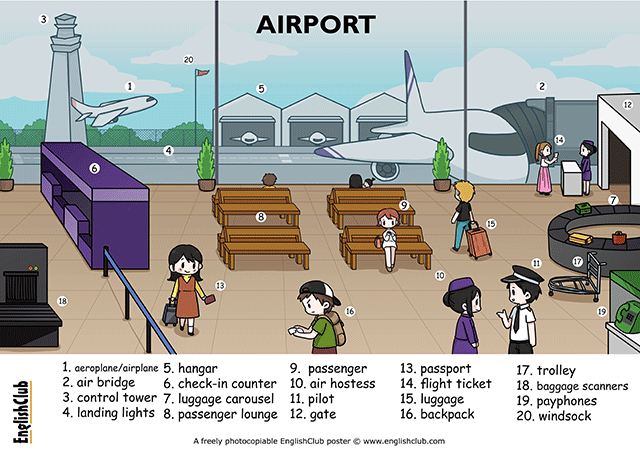
- airplane, aeroplane, plane: We boarded the plane and waited for it to take off.
- air bridge: We walked through the air bridge and onto the plane.
- control tower: The staff inside the control tower can see all the planes taking off and landing.
- landing lights: The runway was illuminated by the landing lights.
- hangar: The enormous hangar was full of half-finished planes.
- check-in counter: I walked up to the check-in counter and presented my passport and ticket.
- luggage carousel: We waited at the luggage carousel until our luggage finally arrived.
- passenger lounge: Before boarding my flight, I spent a few hours relaxing in the passenger lounge.
- passenger: Attention all passengers flying on flight KM106 to Rome. Please proceed to gate 11.
- air hostess: The patient air hostess looked after us throughout the flight.
- pilot: Thanks to the skilled pilot, we had a very smooth landing.
- gate: By the time we got to our gate, most of the passengers had already boarded the plane.
- passport: My passport is full of stamps from all the countries I’ve visited.
- flight ticket: When I checked in at the airport, I had to present my passport and my flight ticket.
- luggage: After getting off the plane, we went to collect our luggage.
- backpack: I carry everything I need inside my backpack.
- trolley: We pushed our luggage through the airport on a metal trolley.
- baggage scanners: Before entering the departure lounge, we had to put our luggage on the baggage scanners.
- pay phones: I needed to make a phone call, so I headed towards the pay phones.
- windsock: The pilots rely on the windsock to tell them which way the wind is blowing.
They were expecting a valuable parcel of diamonds from South Africa.
量词
- a package of 一包,一袋,一盒,一罐等包装的物品
- a box of 一盒,一箱:指一种装有某种物品的盒子或箱子。
- a glass of 一杯:一种或一定量的饮料装在玻璃杯中。
A few hours earlier, someone had told the police that thieves would try to steal the diamonds.
a few hours earlier = a few hours before / a few hours ago 几个小时以前
try to do 努力做...(表示尝试去做某事或努力去完成某个任务。)
- I will try to finish the project before the deadline. (我会尽力在截止日期之前完成这个项目。)
- She tried to fix the broken computer herself. (她试图自己修理那台坏了的电脑。)
| 主句(tell sb. sth. 双宾语结构) | 引导词 | 从句 |
|---|---|---|
| someone had told the police | that | thieves would try to steal the diamonds. |
过去将来时
| would + v.(动词原型) | was/ were going to + v.(动词原型) |
|---|---|
| 过去的将来,以间接方式, 转述, 站在过去看未来,过去将来时不会单独出现,必须搭配过去时使用。 | |
| He said that he would travel abroad next year. | He said that he was going to travel abroad next year. |
一般将来时: will + v.(动词原型)、 is/am/are going to + v.(动词原型)
When the plane arrived, some of the detectives were waiting inside the main building while others were waiting on the airfield.(表达多个同时发生的动作)
| some … others … “有些(人)…,也有些(人)…”或“有的…,其余的…” | one…the other… 一个…另一个… | others = other + 名词复数 |
|---|---|---|
|
|
|
3个动词3件事(连接方式When + 1 ,2 + while + 3)
- The plane arrived.
- They were waiting inside the main building.(They = some of the detectives一些侦探)
- They were waiting on the airfield. (They = others 其它剩余的人)
Two men took the parcel off the plane and carried it into the Customs House.
take sth. off… = take sth. away from… 远离:离开某个地点或者远离某个对象的状态或行为。
take 词本意:脱离
- He took off his coat. 他脱离了他的外套
- The plane will take off. 飞机将要脱离(起飞)
While two detectives were keeping guard at the door, two others opened the parcel. (过去进行时+一般过去表正在进行的同时发生另一件事)
keep guard 守卫
- They kept a close guard over the thieves.
at the door 在门边(固定搭配)
To their surprise, the precious parcel was full of stones and sand!
| (分工协作)…were keeping guard at the door, | two others opened the parcel. |
|---|---|
| 延续时间长的动作用进行时态 | 短时间(瞬间)的动作用过去时 |
| I was having dinner. | When someone knocked at the door, |
To one’s + 表达人情绪的名词
| to one's surprise 让某人惊讶的是 | to one's joy 让某人高兴的是 | to one's excitement 令人激动(或兴奋)的事 |
|---|---|---|
| To my surprise, the teacher was late. | To my joy, my mother came here yesterday. | To our excitement, our team wins. |
be full of ... 装满
- My bag was full of books.
- The cup is full of water.