
at the butcher’s 在肉店
| 一般现在时 | 一般过去时 |
|---|---|
| Are you at the butcher’s? 你现在在肉店吗? | Were you at the butcher’s? 你刚在肉店吗? |
How’s Jimmy today? 口语才缩写
How is…? ’s 缩写 (is was has),需要根据时态去分析
- Lord, how is this, Joe? 天哪,这是怎么回事,乔?
- How is that written? 这是怎么写的?
- Prithee, how was it known? 请问,这是怎么知道的呢?
- How has she done it? 所以她是怎么做到的呢?
Was he absent from school last week?
be absent from... 缺席...
- He will be absent from the meeting tomorrow.他明天将缺席会议。
- He has been absent from his desk for two weeks. 他已经两个星期没来了。
How are you (all keeping)? 你好吗?
- How are you doing?
- Hi.
- What's up?
- Good to see you.
- How are things (with you)?
We 're going to spend three days in the country.
| 主语 | 花钱 | 花时间 |
|---|---|---|
| 人 | spend | spend |
| 物 | cost | take * |
at my mother’s. 在我妈妈家
人+'s \ 职业 + ‘s 可以表示这个人/职业所有的地方
- at the butcher’s 在肉店
- at the hairdresser's 在理发店
* Aren't you lucky! 否定疑问句,这里表感叹“你们可真幸运啊!”,表强烈的感叹。
- Aren't you surprised! 你不觉得很惊讶吗!
- Aren't you tired! 难道你不累吗!
- Aren't you forgetting something? 你没忘了什么东西吧?
- Aren't you pleased to see me? 见到我你不高兴吗?
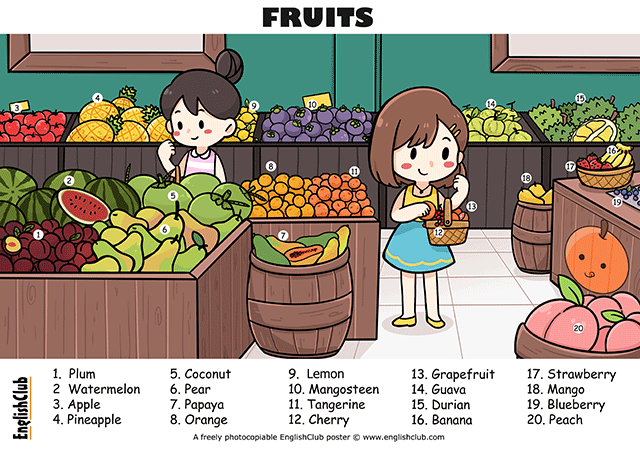
- apple: The fruit bowl was full of red and green apples.
- banana: I peeled the banana and took a big bite.
- blueberry: I had a bowl of blueberries for breakfast this morning.
- cherry: After eating the sweet cherry, I spat out the hard stone.
- coconut: We had to break the shell of the coconut to get to the white meat inside.
- durian: Although I like the taste of durian, I really don’t like the smell.
- grapefruit: I cut the grapefruit in half and ate it with a spoon.
- guava: The guava was green on the outside and pink on the inside.
- lemon: I cut a slice of lemon and put it in my drink.
- mango: The orange flesh of the mango was sweet and juicy.
- mangosteen: I removed the purple skin of the mangosteen and ate the sweet white flesh.
- orange: The oranges on our tree are sweet and excellent for juicing.
- papaya: I cut the papaya in half and removed the small black seeds.
- peach: After finishing the juicy peach, I threw the stone in the bin.
- pear: The pear was still quite hard and not ready to be eaten.
- pineapple: Before eating a pineapple, you must remove the rough brown skin.
- plum: The plums on our tree are purple and sweet.
- strawberry: I went into the garden and picked some red strawberries.
- tangerine: The tangerine was sweet and juicy but had a lot of small white seeds.
- watermelon: I took the huge watermelon out of the fridge and cut myself a slice.