Yesterday afternoon Frank Hawkins was telling me about his experiences as a young man.
… as he was a young man 状语从句的省略
前提:1. 从句主语和主句主语一致;2. 从句中需有 be 动词。省略时需把从句主语和 be 动词一起省略。从句:when /if/though /although/once /unless/wherever + (主语 + be) + 形容词 / 分词 可以直接删掉 主语 + be。
- He fell asleep when
he was doing his homework.
- When I was surfing the net, the power was off. 不可省略(主语不一致)
- His father died when he was only three. 不能省略(主语不一致)
- He always wet the bed when
he was a boy.
- When I say I love you, I mean it. 不能省略(没有 be 动词)
- While (he was) waiting, he read a newspaper. 他等候的时候看报纸。
- Unless (you are) invited, don’t come in. 除非受到邀请,否则不要进来。
- Once (they are) found, the mistakes must be corrected. 错误一旦发现就必须改正。
- Though (she was) tired, she kept working. 虽然很累,她仍然继续工作。
- If (you are) asked, please tell the truth. 如果被问到,请讲真话。
特例:当从句主语是 it 后有 be 动词时,也可以把 it 和 be 一起省略。
- Call me when
it is necessary. (从句主语是虚义 it,所以 it is 可省)
- Come early if (it is) possible. 有可能的话早点来。
- Don’t speak unless (it is) required. 除非要求,否则不要发言。
- Fill in the blanks where (it is) appropriate. 在合适的地方填空。
- When (it is) in doubt, ask the teacher. 有疑问就问老师。
tell sb. about sb./sth. 向某人讲述关于某人/某物的情况
- He has been telling me about you. 他一直在跟我说起你。
- —It’s so hard. —Tell me about it. ——这太难了。——可不是嘛。
| tell sb. sth. 告诉某人某事 |
Please tell me your name. 请告诉我你的名字。 |
Before he retired, Frank was the head of a very large business company, but as a boy he used to work in a small shop. §
the head of + 名词 …的老板,头、负责人
- John is the head of the family. 一家之主
- Frank is the head of the firm. 弗兰克是那家公司的总裁。
used to do sth. 过去常常, 但是现在不做(可替代过去时)
I used to think I had the answers to everything but now I know life doesn’t always go my way, yeah...
- My teacher used to live there. 我的老师过去住在那(现在不住了)
- I used to drink a lot of coffee. 我过去常常喝咖啡
- We used to live in the countryside. 我们过去常常住乡下
- People used to be happy when they were young. 人们年轻的时候是幸福的。
|
一般过去时
|
- He lived there. 他过去住在那(不知道现在是否住在那)
- I drinked a lot of coffee. 我喝了很多咖啡
- We lived in the countryside. 我们住在乡下。
- People were happy when they were young. 人们年轻的时候很快乐。
|
| be used to do … 被用来做…… |
|
| be/get/become used to sth./doing… 习惯于某事/做某事 |
|
as a boy = as he was a boy as 的意思是“当…的时候”
- He was as a young man. 当他年轻的时候
- … as
he was a young man 状语从句的省略
| work…as… 作为…工作 |
He used to work as a teacher.他过去是一名教师。 |
* It was his job to repair bicycles and at that time he used to work fourteen hours a day.
- At that time, I lived in a small village. 在那时,我住在一个小村庄。
- I was about to leave. Just then, the phone rang. 我正要离开,就在那时电话响了。
- At that moment, I knew I was wrong. 在那一刻,我知道我错了。
| job 职业 |
work 工作内容 |
| You haven't chucked your job!你还没有辞掉你的工作! |
She started work last Monday.她上个星期一开始工作。 |
| Are you qualified for this job?你有资格担任这项工作吗? |
They work terrifically fast.他们工作极快。 |
He saved money for years and in 1958 he bought a small workshop of his own.
用 of one's own 或 one's own 由被修饰词的位置决定, 如果被修饰名词在前边, 用of one's own, 如果被修饰名词在后边, 用 one's own。
of one's own 自己的,属于自己的(own 为代词)
- Do you have a house of your own? 属于你自己的房子
- I need a room of my own.
- We have problems of our own.
| sb. own sth. (own 起强调作用, one's 自己的) |
- my own book 我自己的书
- I need my own room.
- We have our own problems.
|
In his twenties Frank used to make spare parts for aeroplanes.
in one's -ies 在某人几十岁的时候
in one's twenties/thirties/forties/fifties/nineties,十的倍数的复数形式可用于表达近似的、非确定的数量,与所有格形容词连用时表示大约的年龄。
- in my fifties 在我五十多岁的时候
- In his fifties, he learned the second language. 他五十多岁了才学习第二语言
| in the 1980s 在二十世纪八十年代 |
I worked / began the job in the 1990s. |
In a few years the small workshop had become a large factory which employed seven hundred and twenty-eight people.
has become 成长为…
- Health and fitness have become big business.保健已经成为大生意。
- Wearing fur has become unfashionable. 穿裘皮服装已经变得不流行了。
- He had become a midshipman at age sixteen. 他16岁就已经成了一名海军学校学生。
| get 逐渐变得 |
It can even help sick people get better. 它甚至可以帮助病人康复。 |
| grow 成长变得 |
We are trying to grow the business. 我们正在努力扩展业务。 |
| turn 转变 |
The sea would turn pale pink and the sky blood red. 大海将变成浅粉色,而天空将变成血红色。 |
| become 身份变 |
He's become quite a fundi on wine. 他成了葡萄酒的行家。 |
in a few years 在一些年之后
- In a few years he had climbed to the top of his profession. 他在几年内攀上了职业的巅峰。
- Do you remember that play I was in a few years ago? 你还记得几年前我参演的那出戏吗?
…factory which employed… 工厂雇佣…(除了人可以雇佣外,工厂、公司也可以这样表达)
- Nearby was a factory which exuded a pungent smell. 附近是一家散发出一种刺鼻气味的工厂。
- This is the factory which I visited. 这就使我参观过的工厂。
- The factory which produces cars is over there. 生产汽车的那家工厂就在那边。
Frank smiled when he remembered his hard early years and the long road to success.
one’s hard early years = early in one’s hard life 某人的早年艰辛(生活)
- the long road to success 通往成功的长路
- There is a long way to go. 还有很长的路要走。
remember v. 记得, 回忆起
- I did remember, but only dimly. 我的确记得,只是记不太清楚了。
| memory n. 记忆 |
memorize v. 记住 |
| He had a good memory for faces.他对相貌有很好的记忆力。 |
I memorize speeches word for word.我一字不差地背演讲稿。 |
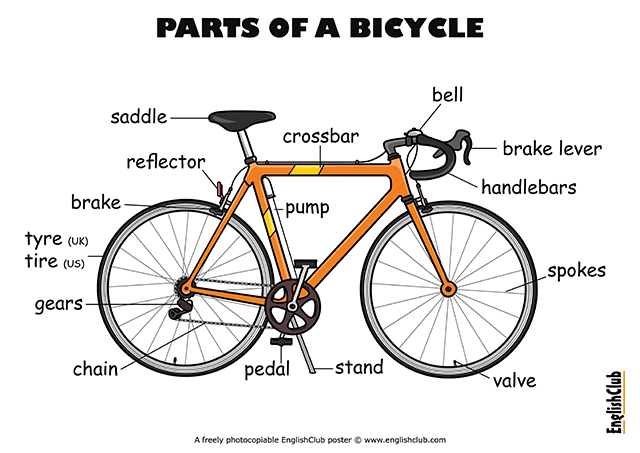
She wanted him to repair their grandson's bicycle!
- chain: The bike chain moves whenever I start pedaling.
- gears: As the ground became flatter, I changed gears.
- tyre/tire: Both my tyres need more air.
- brake: I used the brake to stop the bike.
- reflector: I was able to see the cyclist because of his reflector.
- saddle: The saddle on my bike was too high, so I got James to lower it.
- crossbar: I put my leg over the crossbar and started to pedal.
- pump: I used the pump to put air in my tyres.
- bell: I ring the bell to let people know I’m behind them.
- brake lever: I wanted to stop, so I pressed the brake lever.
- handlebars: I put my hands on the handlebars and started to cycle.
- spokes: The wheels were turning so quickly that I couldn’t see the spokes clearly.
- valve: The valve on the bike regulates the air coming in and out of the tyres.
- stand: The bike will fall over if you don’t put down the stand.
- pedal: I put my feet on the pedals and started to cycle.