
Joe Sanders has the most beautiful garden in our town.
你喜欢、较喜欢、最喜欢?
- Which garden do you like? ⇒ I like Joe's garden.
- Which garden do you like more? ⇒ I like Bill's garden more than Joe's.
- Which garden do you like the most? ⇒ I like the worst / best garden the most.
| 主谓 | the + adj. / adv. 最高级 | 最高级的范围 |
|---|---|---|
| Joe's garden is | the most beautiful | in our town. |
| Bill's garden is | the largest |
Nearly everybody enters for 'The Nicest Garden Competition' each year,
enter for 报名参加(各种竞赛,考试等活动)
| nearly adv. 几乎,差不多;密切地,亲密地;即将,就要 | almost adv. 几乎,差不多 |
|---|---|
| I have nearly forgotten his name. 我差点把他的名字忘了。 | I’m nearly / almost ready. 我快准备好了。 |
but Joe wins every time.
| win | won | won |
|---|---|---|
| vi. 赢 | I win / lose.(赢/输) | |
| vt. 赢得… (win something 后面往往是奖品,不能接对手) |
|
|
| defeat + 对手 | I defeat you. | |
Bill Frith's garden is larger than Joe's. 被比者 + be + adj./adv.比较级 + than + 比较的对象
比较的东西都是同类的事物 joe’s 的“’s”不能省略,名词加-’s 表示所属关系,构成名词的所有格。这类名词往往指有生命的东西,特别是人。所有格的语法作用相当于形容词,限定后面的名词。这个被限定的名词在上下文中第二次被提到时可以省略,只要不引起误解。
- My eyes are bigger than yours. 我的眼睛比你大(中文说得不够严谨)
- Your hat is larger than mine. 你的帽子比我大(英语需要使用所有格,要标明比我的帽子大,而不是比我这个人大)
- I eat more salt than the rice you eat. 我吃盐比你吃的饭还多。
Bill works harder than Joe and grows more flowers and vegetables, but Joe's garden is more interesting.
| Bill works harder | than | Joe. 比尔比joe更努力 |
| Bill grows more flowers and vegetables. 比尔种植了更多的花与菜 | 上下文一致时,可以省略比较对象。 | |
| but Joe's garden is more interesting. 但是Joe的花园比Bill的更有意思 | ||
He has made neat paths and has built a wooden bridge over a pool.
| make 词义比较笼统、广泛,可解释为“做、作出、制造”等 | build 主要限于建筑业,指“建造,建设,盖房子,修筑(桥梁)等” |
|---|---|
| make 和build 在这里是同义词,“修建,建造”。 | |
|
|
Every year I enter for the garden competition too, and I always win a little prize for the worst garden in the town!
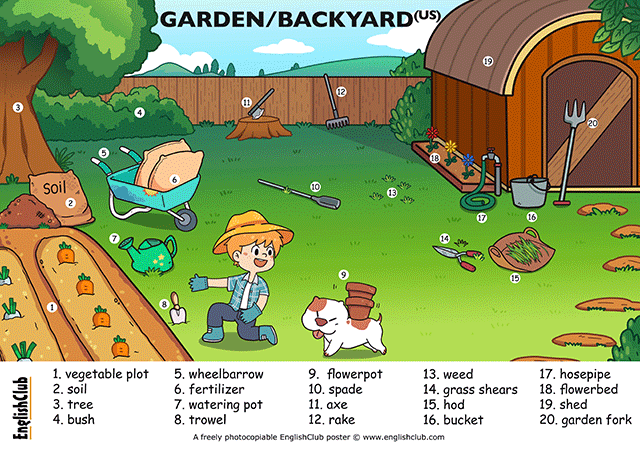
- axe: I used my axe to chop some wood for the fire.
- bucket: We filled the bucket with water.
- bush: There is a beautiful bush growing in my garden.
- fertilizer: We mix fertilizer into the soil to help the plants grow.
- flowerbed: There are many flowers growing in the flowerbed.
- flowerpot: There is a plant growing in the flowerpot.
- garden fork: I used the garden fork to mix the fertilizer into the soil.
- grass shears: I picked up the grass shears and started cutting the grass.
- hod: I picked some beans and put them in my hod.
- hosepipe: Alice turned on the hosepipe and started watering the grass.
- rake: I use my rake to collect the autumn leaves.
- shed: We have lots of tools in our shed.
- soil: I planted some seeds in the soil.
- spade: Sam used the spade to dig a large hole.
- tree: There’s a large apple tree in our garden.
- trowel: I picked up the trowel and started to dig.
- vegetable plot: We have carrots and potatoes growing in our vegetable plot.
- watering can, watering pot: Peter watered his roses with a watering can.
- weed: There are too many weeds growing in our garden.
- wheelbarrow: Jim pushed the wheelbarrow full of soil across the garden.