
After her husband had gone to work, Mrs. Richards sent her children to school and went upstairs to her bedroom.
| send sb. to + n. / to do 打发去... |
|
|---|---|
| dispatch sb. to + n. / to do 打发、派遣去.. |
|
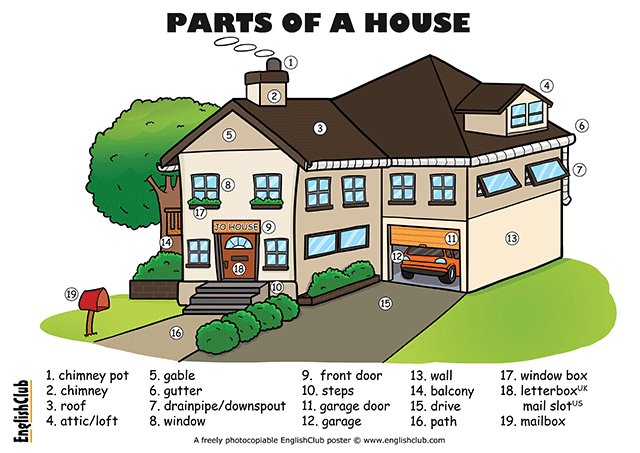
- attic: The attic is at the top of the house.
- balcony: I sat on the balcony and drank a beer.
- chimney: There was smoke coming from the chimney.
- chimney pot: There is a chimney pot on top of the chimney.
- downspout: There was a lot of water coming out of the downspout.
- drainpipe: There was a lot of water coming out of the drainpipe.
- drive, driveway: Gary’s red car was parked in the drive.
- front door: There was someone knocking at the front door.
- gable: There is a gable under the roof.
- garage: I park my car in the garage every evening.
- garage door: I had difficulty opening the garage door.
- gutter: After the rain, the gutter was full of water.
- letterbox (UK): I pushed the letter through his letterbox.
- loft: The loft is at the top of the house.
- mailbox: There were a few letters in our mailbox.
- mail slot (US): I pushed the letter through his mail slot.
- path: There was a path leading up to the house.
- roof: The bird was sitting on the roof.
- steps: We had to walk up a few steps to get to the house.
- wall: The walls of the house had been painted white.
- window: I looked through the window to see if anyone was at home.
- window box: There were flowers growing in the window box.
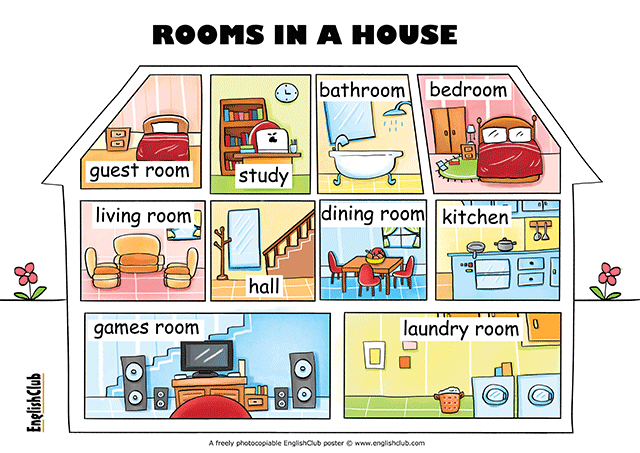
- bathroom: Jim was in the bathroom brushing his teeth.
- bedroom: I went into my bedroom and got into bed.
- master bedroom: The master bedroom in a house is the largest bedroom.
- storeroom: you keep things until they are needed.
- dining room: We always have dinner in the dining room.
- games room: Whenever I have friends over, we play games in the games room.
- guest room: When my grandmother comes to stay, she sleeps in the guest room.
- hall: I walked down the hall and into the kitchen.
- kitchen: Mum was in the kitchen cooking dinner.
- laundry room: We wash all our clothes in the laundry room.
- living room: When guests come to visit, we have coffee in the living room.
- study: Dad does all his work at the desk in his study.
- basement:it is a floor built partly or completely below ground level.
- cellar:it is a room underneath a building, which is often used for storing things in.
She was too excited to do any housework that morning, for in the evening she would be going to a fancy-dress party with her husband.
| housework 家务(不可数) |
|
|---|---|
| homework 家庭作业(不可数) | |
| household chore 杂活(可数) |
| will be doing 将来进行时(可预见的将来) | He will soon be working in an office. He will be earning only half as much as he used to, ... |
|---|---|
| would be doing 过去将来进行时(站在过去看将来) | Duff said he would be demanding a rematch. 达夫说他会要求重赛。 |
| (fancy-dress) costume 化妆舞会的服装 |
|
|---|---|
| fancy-dress party = masquerade 化妆舞会 |
She intended to dress up as a ghost and as she had made her costume the night before, she was impatient to try it on.
| intend to do 打算做某事 | We intend to go to Australia next year. |
|---|---|
| tend to do 倾向于做某事(易混淆) | Women tend to live longer than men.女人往往比男人长寿。 |
| mean to do 打算、有意做某事 | He always meant to go back one day but not to stay. NCE3-57 |
| be going to do 一般将来时(打算做某事) |
|
| have every intention of doing ... 有意做某事(名词更正式) | I had every intention of phoning her this morning, but I just didn't get a chance. |
| have no intention of doing ... 无意做某事(no 否定名词) | I had no intention of buying one, but I could not conceal the fact that I was impressed by the size of the diamonds. |
the night before 前一天的晚上
- the earlier / previous / preceding night 头一天晚上(替换)
- the night after 第二天晚上(某一天的转天晚上)
- the next / following / succeeding night 在接下来的一天晚上(第二天晚上)
| dress up as ... 装扮成... | They all dress up as doctors. 他们都打扮成医生模样。 |
|---|---|
| dress sb. up as ... 把某人装扮成... |
|
| disguise sb. as ... 必须及物(把某人装扮成...) | He disguised himself as a dustman. 他化装(装扮)成清洁工。 |
| disguised as ...(非谓语) | Alfred the Great acted as his own spy, visiting Danish camps disguised as a minstrel. NCE4-9 |
| be impatient to do ... (等得)不耐烦的去做某事 | be eager / anxious / itching / desperate / dying to do ...写作替换 |
|---|---|
| can't wait to do ... 等不急要去做某事 | We can't wait to get started. 我们迫不及待地想要开始了。 |
Though the costume consisted only of a sheet, it was very effective.
Though the costume was composed only of a sheet, ... 替换
After putting it on, Mrs. Richards went downstairs.
She wanted to find out whether it would be comfortable to wear.
形容词后的动词不定式做补语用主动结构
- He is easy to fool. ↔ To fool him is easy.
- it would be comfortable to wear. ↔ To wear it would be comfortable.
- She is extremely difficult to please. ↔ To please her is extremely difficult.
- The machine is awkward to handle. ↔ To handle the machine is awkward.
- The man is hard to work with. ↔ To work with the man is hard.